Can Following the Food Guide Make You Fat?

Both Canada and the US have versions of a food guide which outlines recommended daily intakes for the four main food groups. Started during the rationing of WW2, both countries have revised their guides a number of times since then.

Canada’s last revision was in 1992 where we went from “the four food groups” to a rainbow design to show that some items can and should be consumed more frequently. The US went with a pyramid design, although both guides are fairly similar in regards to quantities.

The main thing both guides have in common is that both are heavily influenced by the various food lobby groups (what boards, cattle farmers associations, dairy boards, etc) whose clients have a vested interest in having the goverment encourage people to eat specific foods.

The revised Canadian guide was supposed to have been released in spring 2006, and is now slated for some time in early 2007.

Continue reading “Can Following the Food Guide Make You Fat?”

Salad Days

People should not throw wedding receptions on Daylight Saving Time switch overs. Or at least not the day after. We went to a wedding reception last night and stayed out far too late and drank far too much. There were drink tickets and the G&T’s were being made with premium gin and an 8 to 1 ratio of G to T. There was much dancing and eating of cake and sushi, not to mention the spitting out of little tiny quiche upon the discovery of the bacon contained therein.

This morning, after little sleep, combined with too much booze and too much dancing (there’s nothing like a gay wedding for good tunes on the dancefloor), I’m feeling a bit rough around the edges.

Ever since I can remember, a hangover demands a salad. My body just wants something fresh and crisp and cold. I have the makings of an excellent salad in the kitchen, of course, but moving from a reclining to a standing position causes me to emit loud “Urrrnnnnggghhh!” noises reminiscent of Lurch from the Addams family.

The quick lunch choices in our immediate vicinity are few. Two burger joints, two sub places and a roti place which, while I typically adore the roti place, didn’t sit well in my brain today.

Continue reading “Salad Days”

I’m Not Fat, I’m Festively Plump

Denial – not just a river in Egypt.

A recent study of obese adults indicated that 75% of them claim to have healthy eating habits, while 40% claim to exercise vigorously 3 or more times a week. Doctors are not sure whether the study participants are in denial, or if they simply don’t know what constitutes a “healthy diet” or “vigorous exercise”.

“There is, perhaps, some denial going on. Or there is a lack of understanding of what does it mean to be eating healthy and what is vigorous exercise,” said Dr. David Schutt of Thomson Medstat, the Michigan-based health-care research firm that conducted the survey.

The survey found that 28% of obese participants ate two or more snacks per day, compared with 24% of the normal-weight participants, but no records were kept of exactly what any of the participants were eating, or how much.

“In my experience,” explains consumer health advocate Mike Adams, “very few people truly understand what it means to follow a healthy lifestyle. Most consumers suffer under the dangerous misimpression that processed, factory-made foods can somehow be healthy, even though they are stripped of nutrition and laced with chemical additives,” he says. “Part of the problem is that the FDA allows food companies to make ridiculous health claims, such as claiming that chocolate milk powder, made primarily with processed sugar, is good for kids’ bones because it contains a tiny amount of supplemental calcium.”

Continue reading “I’m Not Fat, I’m Festively Plump”

Healthy Breakfasts

Breakfast is the most important meal of the day. It’s true. That’s not just something made up by the cereal companies. Yet this most important meal is often overlooked or neglected by the majority of North Americans as we rush to get out the door each morning.

The way I see it, our problem is two-fold. First, we are over-scheduled and under-organized and just don’t have the time (or don’t think we have the time) to sit down each morning for breakfast. We rush and hurry and end up grabbing something supremely unhealthy like a donut or a granola bar. Secondly, North Americans just don’t think of their first meal of the day as being “breakfast” unless it looks like a Denny’s Grand Slam.

I mean, stop for a minute and think of your favourite breakfast foods. There’s probably some eggs, bacon, of course, pancakes, waffles, toast… Now who wants to get up and cook that for their family each and every morning? My Grandmother used to, but only because she had to, and just recently she admitted to me that she, the woman who inspired my love of food, hates cooking with every fibre of her being – mostly because of having to get up every single day for 50 years to cook breakfast! If my Grandmother, with her pancakes shaped like Mickey Mouse isn’t up to cooking breakfast, then what hope is there for the rest of us?

Continue reading “Healthy Breakfasts”

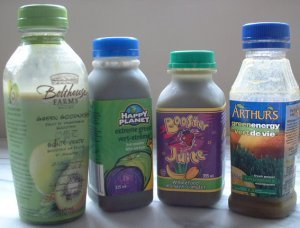
Drink Your Greens

There’s nothing like a tasty glass of pond slime to get you started in the morning.

You’ve probably seem them in the supermarket, those bottles of icky green stuff, slotted in with the fancy juices and smoothies. With names like Green Goodness, Extreme Green and Green Energy, they are marketed in such a way as to make you feel super-healthy and pious after drinking one. But are they really the wonder food they’re made out to be?

First, it’s important to note that in all of the products I tested, the primary ingredients are various types of juice; apple, banana and mango top the lists, although some include pear, kiwi, pineapple, and even green tea. But the ingredient that we’re concentrating on is the one that gives each product its distinctive sludgy green colour – spirulina.

Spirulina is a type of blue-green algae, of which there are approximately 1500 species. It is named for its coil-like shape. According to Wikipedia:

Spirulina is a low fat, low calorie, cholesterol-free source of protein containing all the essential amino acids. It helps combat problems like diabetes, anemia and atmospheric pollution. It also helps combat ‘free radicals’ which can lead to ailments like cancer, arthritis, cataracts. Moreover, the gamma-linolenic acid (GLA) present in spirulina dissolves fat deposits, helps prevent heart problems and reduces “bad cholesterol”. The National Cancer Institute, USA, has additionally announced that sulfolipids in spirulina are remarkably active against HIV. Regular intake of spirulina increases anti-viral activity, stimulates the immune system, reduces kidney toxicity, improves wound healing and reduces radiation sickness.

However there is little scientific evidence of the nutritional value of spirulina and blue-green algae and there are many respected sources, such as The Berkeley Wellness Letter who believe there are none. Moreover it has been suggested that such supplements can be easily contaminated with microcystins and heavy metals (see above link). A court in California deemed thirty health claims made by one supplement producer to be false. From the ruling: “[The] defendant’s advertising as to the need for and benefits from defendant’s product imply that there is some reliable scientific basis for the claims such as would be reasonably expected by potential users. There is not.” (more details of court ruling). At this point all claims regarding the health and nutritional benefits of spirulina and blue-green algae should be viewed with skepticism.

Continue reading “Drink Your Greens”

Fat Politics – You’re Not as Fat as You Think You Are

Fat Politics: the Real Story behind America’s Obesity Epidemic

I am 8 years old. Some of my little friends say there is no Santa Claus. Papa says, “If you see it in The Sun, it’s so.” Please tell me the truth, is there a Santa Claus?
Virginia O’Hanlon

Virginia O’Hanlon’s father instilled in his daughter a respect and expectation of integrity in the fourth estate. If you read it in the newspaper, it must certainly be true. As a society, we continue to follow this philosophy. The Weekly World News and related tabloids aside, we expect our news media to report the facts, and to have done the research required to support those facts.

Which is why I’ve got some shocking news. Despite what every news channel, radio station, newspaper and magazine in the western world would have us all believe, there is no obesity epidemic. I know that we’ve been told that, over and over again – it shows up in the media at least once a week – but the truth behind the reasons why will astound you.

Author Eric Oliver started out with the intention of creating yet another tome of hand-wringing despair about how super-sizing and corn syrup were making us all fat. Yet when he dug deeper into the research, when he searched deep down into all of the sources at his disposal, he discovered that America’s Obesity Epidemic is nothing but a huge sham.

Continue reading “Fat Politics – You’re Not as Fat as You Think You Are”

When Was the Last Time You Ate a Shirt?

I want you to find the nearest bag of potato chips. Hint – if you can reach it without leaving your computer chair, that’s a bad thing. Now, read the ingredients list. Unless your potato chips are the super-swank high-end organic kind, I’d bet dollars to donuts that somewhere in that list is either vegetable oil or cottonseed oil. Hint #2 – if it says “vegetable oil”, then quite likely it’s cottonseed oil, at least in part.

Next step, think about this, and it’s not a trick question – when was the last time you ate a shirt?

You’ve probably eaten cottonseed oil a great deal, though, without even realizing it. It’s now one of the standards for frying potato chips because of its high smoke point, mild flavour, long shelf life and low price. If you’ve eaten pastry made with Crisco shortening, you’ve eaten cottonseed oil, although the packaging only lists vegetable oil, and you have to dig hard and deep on the Crisco website to find an ingredients list.

Continue reading “When Was the Last Time You Ate a Shirt?”

Food Fight

Food Fight – The Inside Story of the Food Industry, America’s Obesity Crisis and What We Can Do About It by Dr. Kelly Brownell and Katherine Battle Horgen

The number one rule to remember when reading studies, works of non-fiction, even the news, is that everyone approaches a piece with a bias. When it comes to nutrition studies, the bias often reflects who is paying for the study; in the news, whether the network or paper has a right or left-wing slant. In non-fiction, it comes down to why you’re writing the book and the point you want to get across.

Thus, no matter how much I want to like a book, and to take it seriously, I have to account for the fact that Food Fight was written in part by the Director of the Yale Centre for Eating and Weight Disorders.

This isn’t necessarily a bad thing – certainly Dr. Kelly Brownell is going to know more about the surging obesity epidemic than the average person. But his bias against the evils of obesity shows up early on, and I can’t help but begin to be skeptical.

Continue reading “Food Fight”

Bug Juice

We’ve known for years that the term “natural” when it comes to food is a dubious one. Technically, everything is “natural”, even chemical additives – hey, they started as something found in nature. Any savvy food shopper knows that “natural” as a marketing term is meaningless.

But what about when it comes to the ingredient list? “Natural” flavours and colours don’t necessarily mean that they’ve come naturally from the product at hand, and synthetic colors haven’t necessarily been cooked up in a lab – strawberry candies don’t contain any actual strawberries. But what makes those candy strawberries red?

Bugs. Pretty little red bugs. C’mon. Bugs are natural. Although on ingredients lists, you’ll often find cochineal extract listed simply as “synthetic color”, the product itself is made from dried female cochineal beetles, a tiny insect that lives on cactus plants in Central and South America.

Continue reading “Bug Juice”

Granola Bars – Not For Breakfast Anymore

Remember in the 70s when the humble granola bar resembled a stick of particle board and tasted about the same? We found them in our lunchboxes because they were supposed to be a healthy treat that wouldn’t rot our teeth. Then in the 80s, someone came up with the idea to make those granola bars chewy. With the addition of corn syrup to both sweeten and hold the cereal bits together, the hard nasty granola bar was a thing of the past and the cuts on the roofs of our mouths from the sharp granola corners healed up quite nicely.

Somehow, in the past twenty years when I wasn’t paying attention, the once lauded granola bar went from a healthy nutritious snack to well… candy. First came the chocolate chips, then the chocolate coating, then peanut butter, and finally caramel and even frosting. The scary part is, there are people out there buying these things for their kids (or themselves) believing them to be a reasonable treat, or even a good replacement for a meal.

Continue reading “Granola Bars – Not For Breakfast Anymore”