 Some say Vancouver is overtaking Toronto as the ultimate Canadian foodie town. I don’t travel much, so I can’t vouch for that personally, but love of my city forces me to say, “Is NOT!!” However, Vancouver is definitely attracting some spectacular talent, and I was lucky enough to attend a luncheon recently featuring the dishes of West: The Cookbook
While Geraghty is a UK boy, with training in some of Europe’s Michelin-starred restaurants, West features all the culinary delights of what is local in British Columbia. This, of course, means plenty of fish and shellfish, BC-raised beef, and local fruits and vegetables as well as local foraged delicacies such as chanterelle mushrooms.
Geraghty and his team, as well as a contingent from Top Table and Tourism Vancouver, flew across the country last week, ingredients in tow, to offer some of Toronto’s food writers a west coast treat. Five courses plus canapes were also paired with BC wines.
Canapes
BC Mushroom Arancini
Vancouver Island Octopus with Pemberton Beets
Ballotine of Foie Gras and Salt Spring Island Goats Cheese
Galantine of Theissen Farm Quail and Jasmine Poached Raisins
paired with Sumac Ridge “Stellar Jay” 04, Okanagan Valley
I didn’t get a chance to photograph the canapes, but they were all wonderful. I particularly like the octopus.

 As an editor and a writer, I spend a lot of time reading the works of other published writers, working under the theory that only if you are exposed to great writing can you begin to emulate it. By noticing the tricks and tools that accomplished writers use, another writer can, without copying a particular style, learn to make their own work even more evocative, descriptive and informative. Which means I read a lot of food writing, ranging from poor and amateurish and bland, to pieces that are inspiring, professional and heartfelt. Food and the act of eating being somewhat sensual subject matter, finding a writer who can scatter words onto a page and create a passage as breathtaking as a night sky full of stars is a rare thing indeed.
 Despite being what would inevitably fit into the classic definition of a “foodie”, I don’t buy a lot of cookbooks. As is obvious from this blog, I don’t post a lot of recipes, and while I do love to cook and try new things in the kitchen, I tend not to be a big cookbook collector. Part of this is due to limited space on my kitchen shelves, and part is due to being one of those obsessive Virgo types who chuck anything they haven’t used in a year.
 by Mort Rosenblum was a magnificent read that I thoroughly enjoyed. Which is why I felt it was so important to review it here, and why it’s remained on my desk for the past 3 months as I never seem to have the time to get around to writing a post about it. The downside to this is that I’ve forgotten much of the content of the book, with my single complaint about the publication being that there is no index of places Rosenblum visited or people he talked to or companies he profiled for me to use as a reference, either to find specific passages or simply to jog my memory.


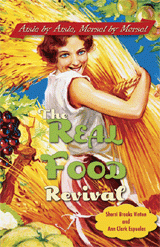 Three years is such a short time in the grand scheme of things, but in the publishing world, it can be an eternity. Books come and books go, and a lot of great books don’t get the publicity they deserve. Which is likely why I was able to find
  by Sherri Brooks Vinton and Ann Clark Espuelas at one of those deep-discount remaindered stores back before Christmas.
 before I even picked it up.
 , I felt that he did an awfully complicated song and dance in the steakhouse chapter to try and justify eating meat. Then I read a quote from In Defense of Food by another blogger which said “Don’t eat anything your grandmother wouldn’t recognize as food”, which riled me up excessively.